



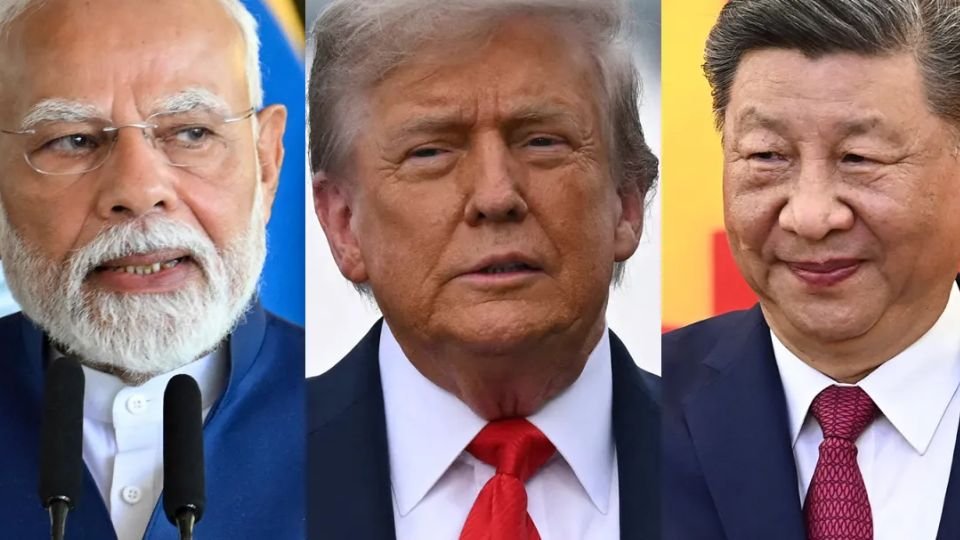
Washington/New Delhi: US President Donald Trump has endorsed a new bipartisan Russia Sanctions Bill that, if passed by Congress, would give the White House sweeping authority to impose punitive tariffs on countries that continue trading in Russian oil, gas, or uranium. The bill, backed by Republican Senator Lindsey Graham, has triggered renewed geopolitical debate as India, China, and Brazil are named among potential nations that could face penalties.
Senator Graham confirmed he met President Trump at the White House on Wednesday, where the US President formally approved the bill, developed jointly with Democratic Senator Richard Blumenthal. A White House official later verified the development in a statement to the Associated Press, calling it a crucial next step in tightening economic pressure on Moscow.
The legislation, co-authored by Graham and Blumenthal, proposes that the US President be empowered to levy tariffs up to 500% on nations that “knowingly purchase Russian oil or uranium and fuel President Vladimir Putin’s war machine”. The bill also covers secondary sanctions on a wider range of Russian exports, including gas and military-linked raw materials, aiming to choke Russia’s primary sources of war financing.
In his statement, Graham described the timing as strategic, accusing Russia of prolonging the Ukraine conflict despite peace concessions by Kyiv. “Putin is all talk, continuing to kill the innocent,” he said, adding that the bill is designed to cripple Moscow economically as negotiations for a peace deal continue.
A Senate vote on the bill could take place as early as next week, though the legislative calendar presents uncertainty. The US Senate is expected to first consider a scaled-down government funding package, followed by a Senate recess scheduled around Martin Luther King Jr. Day. If delayed, the bill may be taken up only after the recess period.
The bill has dozens of co-sponsors in the Senate, along with a companion bill in the US House, drafted by Republican Representative Brian Fitzpatrick, while Republican Representative Brian Fitzpatrick is sponsoring a parallel version in the House. The White House had earlier pushed for revisions to allow flexibility in sanction execution, but officials have not yet confirmed whether those amendments were secured.
Meanwhile, India has maintained that its oil imports from Russia are part of its energy security strategy, not military alignment — a position it has reiterated in the past amid Western criticism. Although no official Indian response has been issued yet regarding the bill, diplomatic analysts warn that if passed, the legislation could mark the harshest tariff threat India has faced from Washington in decades.
Amid these developments, the Trump administration continues working toward a Ukraine peace agreement, led by special envoy Steve Witkoff and Jared Kushner, who are spearheading negotiations on behalf of the White House. US officials believe the bill could be used as a pressure lever in finalising peace talks, but also acknowledge the gamble involved in weaponising tariffs against major trading nations.
The bill’s approval has shifted global oil diplomacy into a new phase, where trade alliances, energy dependency, and national strategy are colliding with US foreign policy. Whether the bill becomes law or stalls in the legislative pipeline, its impact on Indo-US energy and trade discourse is already unfolding.

