



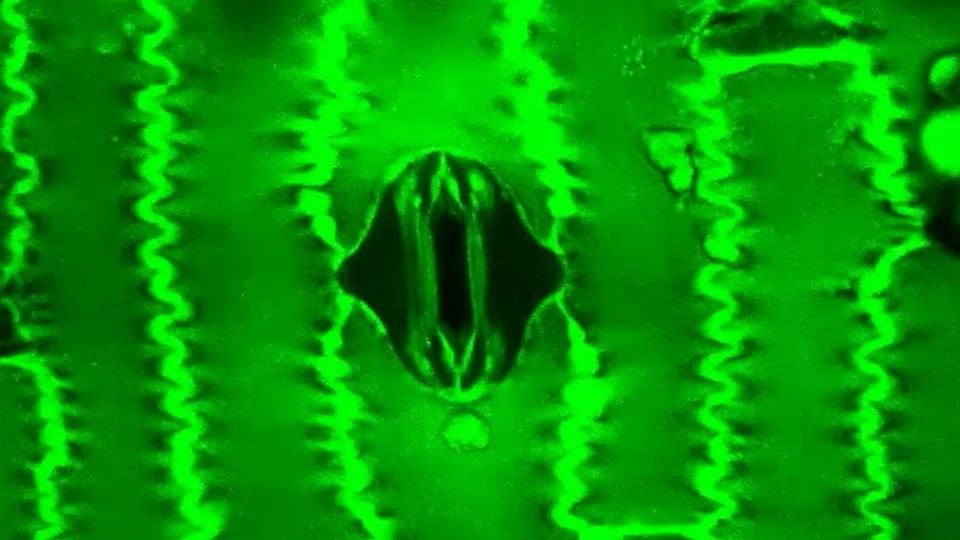
For the first time in scientific history, researchers have been able to directly observe how plants “breathe” as it happens—an achievement that could reshape our understanding of plant survival, agriculture, and water use in a warming world.
A research team at University of Illinois Urbana-Champaign has developed a novel tool that allows real-time visualization of stomata, the microscopic pores on leaves responsible for regulating gas exchange. These tiny structures control how plants absorb carbon dioxide for photosynthesis while releasing oxygen and water vapour, a delicate balancing act essential for growth and survival.
The newly developed device, known as Stomata In-Sight, enables scientists to watch these pores open and close under precisely controlled environmental conditions. Until now, stomatal behaviour could only be inferred indirectly through measurements taken before and after changes occurred. This marks the first time the process has been directly recorded with such clarity and precision.
The technology combines a high-resolution confocal microscope with an advanced gas-exchange system and machine-learning–based image analysis. Small sections of leaves are placed inside a compact chamber where researchers can finely control temperature, humidity, light, carbon dioxide levels, and water availability. This setup makes it possible to see how stomata react moment by moment to environmental stress.
Using the system, researchers captured video footage showing how gases move as plants take in carbon dioxide and release oxygen and water vapour. Subtle cellular changes were tracked as stomata responded to shifts in light, heat, and moisture, offering unprecedented insight into how plants regulate internal balance during stress conditions such as drought and high temperatures.
Explaining the significance of stomatal behaviour, Andrew Leakey from the Department of Plant Biology and the Institute for Genomic Biology noted that plants open these pores in the light to enable photosynthesis and close them in darkness to conserve water. When water is scarce—whether due to hot, dry weather or lack of irrigation—plants limit stomatal opening, which slows growth and reduces productivity.
Developing the system was far from simple. The team spent nearly five years refining the design, addressing challenges such as eliminating even tiny vibrations that could blur microscopic images. After testing multiple prototypes, they arrived at a stable and reliable setup capable of capturing ultra-fine biological movements.
The implications of this breakthrough are far-reaching. By understanding exactly how stomata function—and how their opening, closing, and density are regulated—scientists can identify genetic traits linked to better water-use efficiency. This knowledge could dramatically improve crop-breeding strategies at a time when water scarcity is one of the biggest threats to global agriculture.
As climate change drives higher temperatures and more frequent droughts, crops that can maintain productivity while using less water are becoming essential. Insights from this research could help develop more resilient plant varieties, strengthening food security worldwide.
The University of Illinois Urbana-Champaign has already patented the technology. While it is not yet commercially available, the researchers hope it will soon be manufactured for wider use by plant scientists around the world.
The study detailing this breakthrough has been published in the scientific journal Plant Physiology, marking a major milestone in plant biology and agricultural research.

