



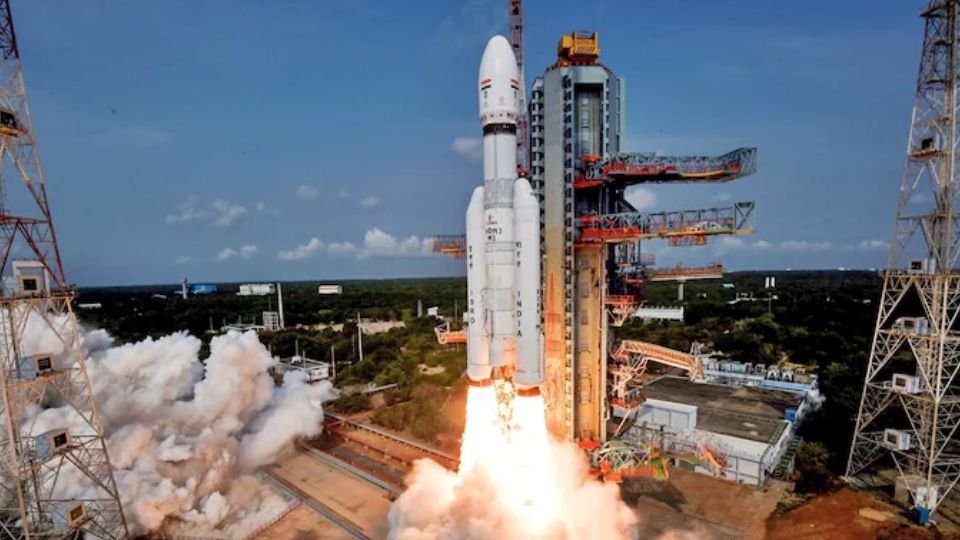
India achieved a new commercial space milestone on Monday as the Launch Vehicle Mark-3 (LVM3-M6) lifted off from Sriharikota, Andhra Pradesh, carrying BlueBird 6 (Block-2)—the heaviest satellite payload ever launched by an Indian rocket. The mission was executed under a commercial launch agreement between NewSpace India Ltd (NSIL), ISRO’s business arm, and US-based innovator AST SpaceMobile.
The 43.5-metre, 640-tonne launcher—powered by twin S200 solid boosters, a liquid core stage (L110) and a cryogenic upper stage (C25)—took flight from the second launch pad at 8:55:30 AM IST after a short 90-second delay to avoid a potential in-orbit collision with debris or passing satellites.
Following a 24-hour countdown, the rocket completed a 15-minute ascent, after which the satellite separated and was precisely injected into a 520-km low-Earth orbit.
What makes this launch stand out
The satellite belongs to AST SpaceMobile’s next-generation BlueBird Block-2 constellation, built to deliver cellular broadband connectivity directly to everyday smartphones, without requiring specialised ground equipment or external antennas. The goal is to beam broadband straight from space to ordinary mobile phones, democratising satellite internet access for mass users.
ISRO Chairman Dr V. Narayanan confirmed the achievement, calling it the third fully commercial mission of LVM3, adding that the vehicle has now demonstrated a global-standard heavy-lift capability and “one of the best performances of any launch vehicle in the global arena.”
Prime Minister Narendra Modi also hailed the mission as a leap forward for India’s commercial launch market, noting that the deployment strengthens India’s role in the global satellite launch industry, particularly for heavy payloads and commercial constellations.
Why the 90-second delay?
ISRO explained that the space over Sriharikota has become increasingly orbital-traffic dense, with thousands of satellites and debris objects passing overhead. The 90-second launch postponement was implemented after collision-risk analysis indicated a possible conjunction risk on the flight path—making the timing shift a safety-first decision, common in modern space operations.
LVM3’s track record so far
LVM3 has now consistently served both national missions and commercial contracts. Previous high-profile launches include:
- Chandrayaan-2 and Chandrayaan-3 lunar missions
- Two OneWeb commercial missions deploying 72 satellites
- Heavy payload capability to Geosynchronous Transfer Orbit (GTO): 4,200 kg
- Earlier successful mission: LVM3-M5/CMS-03 on 2 November 2025
With this launch, India has not only set a payload-weight benchmark, but also reinforced a key trend in global space tech—satellite-to-smartphone internet delivery, reducing dependence on ground hardware and widening accessibility.
As India closes the year on a high note in commercial space operations, the LVM3 platform has now clearly positioned the country as a reliable heavy-lift partner for global satellite companies, expanding India’s footprint beyond scientific missions into strategic commercial space mobility.

