



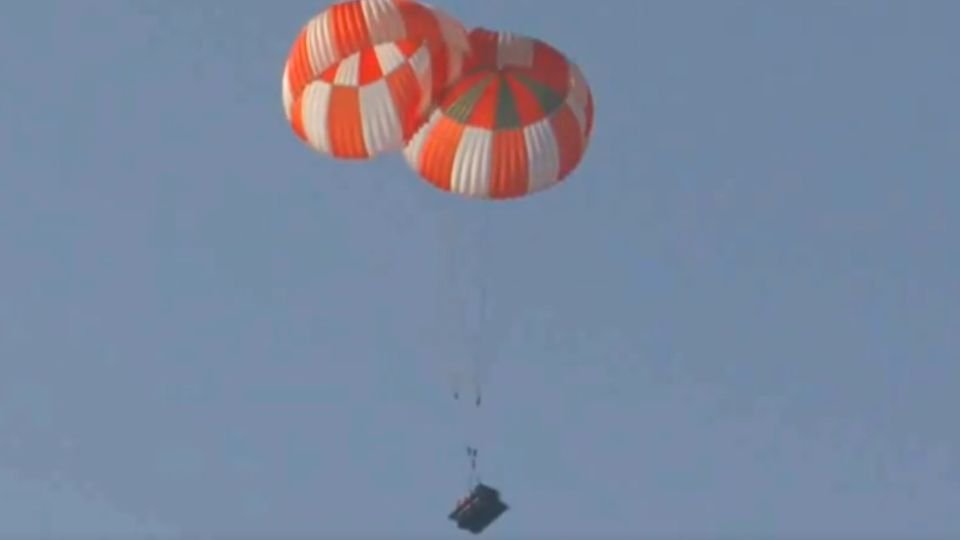
The Indian Space Research Organisation (ISRO) has successfully conducted a crucial test on the main parachutes for the Gaganyaan Crew Module (GCM) at the Babina Field Firing Range in Jhansi, Uttar Pradesh, on November 3.
The test was part of the ongoing series of Integrated Main Parachute Airdrop Tests (IMAT), aimed at qualifying the parachute system for India’s first human spaceflight mission, Gaganyaan.
A simulated mass equivalent to the Gaganyaan Crew Module was dropped from an altitude of 2.5 km using the Indian Air Force’s IL-76 aircraft. ISRO confirmed that the parachute system deployed as planned, with the descent and landing sequence executed flawlessly. The test article achieved a stable descent and soft landing, validating the robustness of the parachute design.
In August, ISRO had successfully conducted the first integrated airdrop test at the Satish Dhawan Space Centre, Sriharikota, using an IAF Chinook helicopter. That test demonstrated the performance of the parachute-based deceleration system for the crew module.
Explaining the sequence, ISRO stated that the Gaganyaan Crew Module parachute system consists of 10 parachutes of four types. The descent begins with two apex cover separation parachutes, followed by two drogue parachutes for stabilization and deceleration. Then, three pilot parachutes deploy three main parachutes that slow down the module for a safe landing.
The system has inbuilt redundancy, ensuring that even two of the three main parachutes are sufficient for a safe touchdown. Using pyrotechnic devices, the main parachutes first open partially (reefed inflation) and then fully after a set delay (disreefing).
This latest test focused on validating the parachute system’s performance under extreme conditions, particularly asymmetric disreefing—one of the most challenging load scenarios expected during actual descent.
ISRO’s Vikram Sarabhai Space Centre (VSSC) led the effort in collaboration with the Aerial Delivery Research and Development Establishment (ADRDE), Defence Research and Development Organisation (DRDO), Indian Air Force, and the Indian Army.
The Gaganyaan mission aims to send a three-member crew into space for three days and bring them safely back to Earth. The programme includes several unmanned test missions to validate systems before the crewed flight.

