



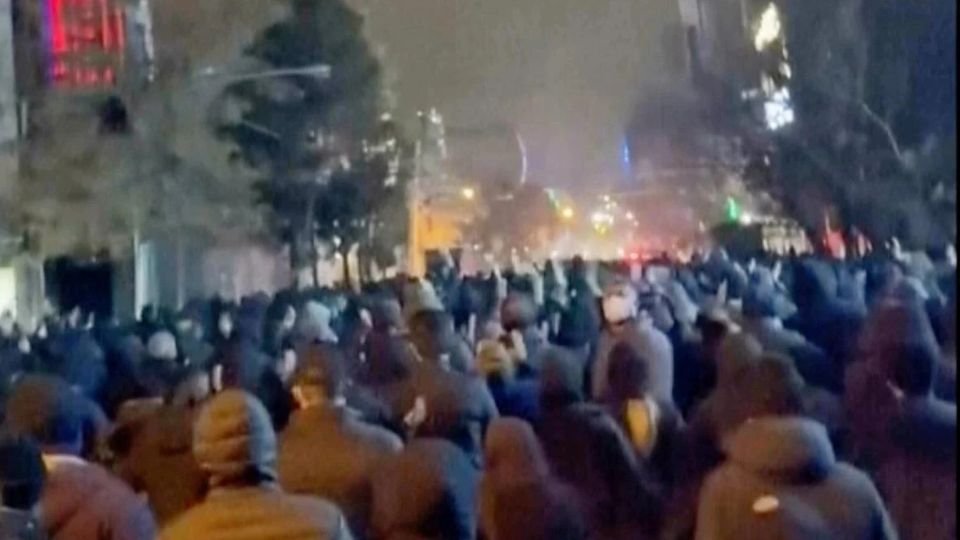
Iran is witnessing its most serious internal upheaval in decades as mass protests continue to spread across the country, intensifying fears that the Islamic Republic itself could be at risk. What began as demonstrations over economic collapse and currency devaluation has rapidly evolved into a nationwide challenge to the authority of Ayatollah Ali Khamenei, with consequences that could reverberate far beyond the Middle East.
Night after night, crowds have filled streets from Tehran to dozens of provincial cities, defying security forces despite a violent crackdown. Rights groups estimate that more than 500 people have been killed and over 10,000 detained in just two weeks. Authorities have attempted to suppress the unrest by blocking internet and phone networks, while international airlines have cancelled flights amid security concerns.
Global capitals are watching closely. The unrest has drawn open encouragement from Donald Trump, who has repeatedly warned Tehran against using lethal force on protesters and hinted that Washington is considering “very strong options.” US military commanders have reportedly briefed the White House on possible strike scenarios, and Trump has said he is monitoring events “very seriously.”
The turmoil has already rattled energy markets. Brent crude prices jumped more than 5%, climbing above $63 a barrel, as traders priced in the risk of disruption in one of OPEC’s largest oil producers. While Iran’s key oil-producing province of Khuzestan has not yet seen major unrest, the uncertainty alone has shifted market sentiment.
Analysts say the situation represents Iran’s most significant crisis since the 1979 revolution. William Usher, a former senior CIA Middle East analyst, described the regime as being under unprecedented strain. He said Iran faces a narrowing window to regain control, driven largely by economic collapse, inflation, and years of sanctions pressure.
The geopolitical implications of a regime collapse would be immense. A fall of the Islamic Republic would deal a major blow to Vladimir Putin, who has already lost key allies following the removal of Nicolás Maduro and the overthrow of Bashar al-Assad. Iran has been a central pillar of Moscow’s influence in the Middle East, providing strategic depth against Western pressure.
Israel, which fought a brief but intense US-backed air war with Iran earlier this year, is reportedly coordinating closely with European governments. Officials say Jerusalem is deeply concerned about the risks of escalation, even as it views the weakening of Tehran as strategically advantageous.
Opposition figures are also attempting to capitalise on the moment. Reza Pahlavi, son of Iran’s last shah and now based in the United States, has called on oil workers to strike — a tactic that proved decisive in bringing down the monarchy in 1978. Any sustained disruption in oil production could rapidly cripple the Iranian economy and accelerate political change.
Yet regional leaders remain deeply uneasy. Gulf states such as Saudi Arabia, the UAE and Qatar fear that a sudden collapse of authority in Iran could unleash chaos rather than stability, echoing the aftermath of the Arab Spring. Iran has warned that any external attack would make US assets and Israel “legitimate targets,” raising the spectre of a wider regional conflict.
Despite its weakened economy and growing public anger, the Iranian state still commands powerful tools. The Islamic Revolutionary Guard Corps, vast internal security forces, and a sophisticated missile arsenal capable of striking targets across the Middle East remain firmly in place. This makes any transition — forced or negotiated — highly unpredictable.
For now, the protests continue, the regime resists, and the world waits. Whether Iran moves toward transformation, prolonged repression, or outright chaos could reshape global energy markets, regional alliances, and the balance of power for years to come.

