



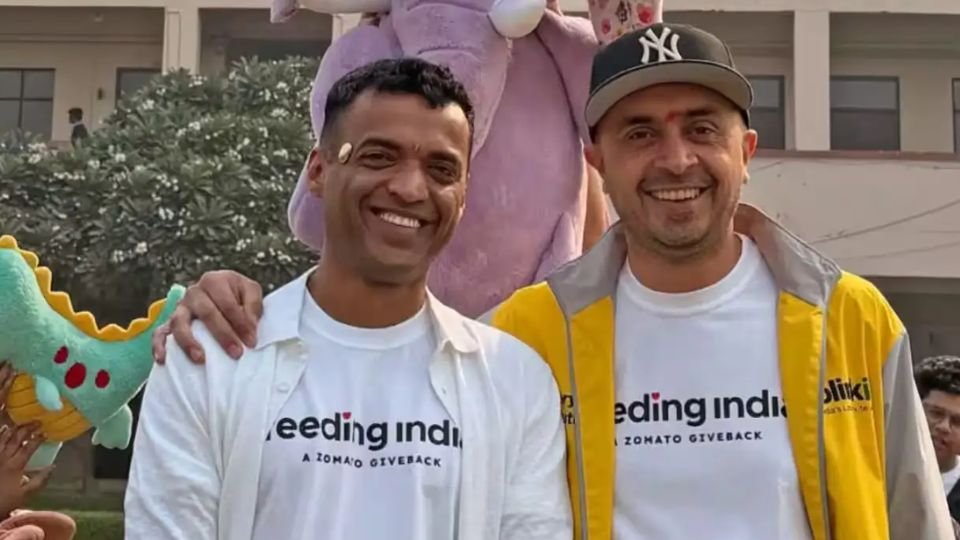
When Zomato founder and Eternal CEO Deepinder Goyal appeared on the Raj Shamani Figuring Out podcast with a small metallic clip affixed to his temple, social media was instantly ignited. Within hours, viewers were flooding comment sections and meme feeds with guesses — “gum?” “charging pad?” “external SSD?” — but the truth behind the unusual accessory is more science experiment than gadgetry humor.
The device Goyal wore is called Temple, an experimental wearable sensor designed to monitor cerebral blood flow in real time. It’s part of a research initiative linked to his privately funded venture, Continue Research, rather than any product from Zomato or Eternal. Goyal has described Temple as a tool to measure “brain blood flow precisely, in real time, and continuously,” and he has reportedly been testing early prototypes on himself for nearly a year.
Goyal’s interest in brain health stems from his long-term personal experimentation with health optimization, including fasting, monitoring biomarkers, meditation, and other longevity practices. This led to his ‘Gravity Ageing Hypothesis’, a theory suggesting that the heart’s struggle against gravity to pump blood to the brain may contribute to ageing. Goyal emphasizes that this idea is not settled science but builds on existing literature.
Temple is not available for public sale, has no launch date, price, or regulatory approval, and remains a research prototype. Goyal has indicated potential early-access phases in the future, and the startup is reportedly exploring significant funding, with interest from well-known investment firms.
Doctors spoken to by NDTV generally agree that brain blood flow is an important area of study, but they express caution about Temple’s claims and its current capabilities.
What Medical Experts Are Saying
Dr. Vishwanathan Iyer, neurosurgeon at Zynova Shalby Hospital in Mumbai, notes that a temple-mounted sensor can only capture surface-level signals and cannot replace clinical tools like MRI scans, which remain the gold standard for accurately measuring cerebral blood flow. He warns that signals from such wearables may reflect indirect indicators like pulse or skin activity, not true brain circulation.
Dr. Sumol Ratna, Assistant Professor of Medicine at NIIMS Medical College and Hospital, echoes this caution. While acknowledging that cerebral blood flow is a valid area for research, he stresses that the core scientific premise connecting gravity to ageing is hypothetical and not widely supported. He also points out that established methods such as fNIRS and MRI remain critical for meaningful measurements.
Gaurav Tyagi, a medical counsellor, describes devices like Temple as “fancy toys” with limited evidence for meaningful impact on ageing or long-term brain health. He emphasizes that traditional lifestyle practices—balanced diet, exercise, cognitive activity—remain the most reliable ways to support brain health.
Dr. Datta from AIIMS Delhi criticized the device on social media, saying it currently “has zero scientific standing” and cautioning people against spending money on unproven gadgets. He also questioned the scientific basis for using the temporal artery as a surrogate for brain circulation.
Dr. Madhukar Bhardwaj, neurologist and head of neurology at Aakash Healthcare, rejects gravity as a major driver of ageing, highlighting that even in microgravity environments such as space, humans continue to age due to molecular, cellular, and metabolic processes.
Bottom Line from Experts
Medical opinion on Temple is clear: while the concept is intriguing and cerebral blood flow is an important research area, current wearable technology is not yet capable of producing medical-grade brain circulation data. Most specialists believe the device should be seen as an experimental research tool, not a validated health product. Its claims, particularly around ageing and brain health, remain speculative without robust clinical evidence.
For now, Temple remains a research prototype under development — interesting from a scientific curiosity standpoint, but far from a proven medical breakthrough.

