



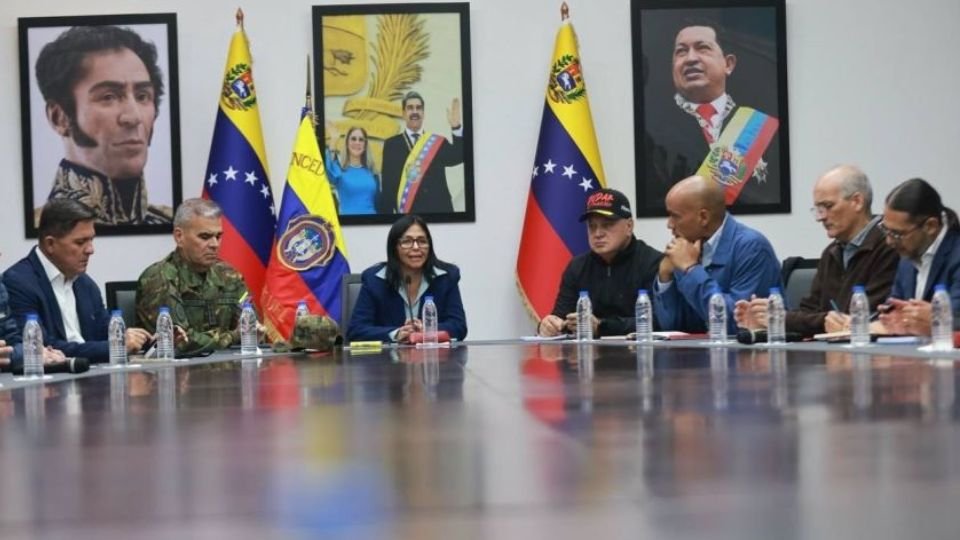
As Venezuela undergoes a major political transition, Delcy Rodríguez — the country’s newly sworn-in acting president — is drawing attention from global oil executives who see her as the most capable figure to stabilise the nation’s struggling energy sector and reopen the door to international investment.
Rodríguez, a seasoned politician and former oil minister, was installed as acting president by Venezuela’s National Assembly last week following the removal of Nicolás Maduro from power. While opposition leader Maria Corina Machado, a recent Nobel Peace Prize laureate, had been touted by some as a symbolic choice for leadership, many US and international oil interests privately favoured Rodríguez. They argue that her expertise in Venezuelan oil affairs and her long-standing relationships with industry figures make her uniquely positioned to navigate sanctions, restructure state oil giant Petróleos de Venezuela, S.A. (PDVSA), and rebuild investor confidence.
Industry lobbyists and executives had lobbied US government officials earlier this year, asserting that Rodríguez — who managed Venezuela’s oil apparatus during years of sanctions and economic turmoil — could offer the continuity needed to revive production. Though major US oil companies were reportedly taken by surprise by Maduro’s ouster, a broad cohort of smaller international firms has engaged with policymakers to advocate for a rapid easing of sanctions if Rodríguez assumes leadership.
Chevron, the only major US oil firm currently licensed to operate in Venezuela, stated it had no prior notice of the regime change and emphasised that its ongoing operations comply with legal requirements. Still, analysts suggest that even Chevron and other firms stand to gain if sanctions are lifted and Venezuelan crude begins flowing again.
During a press briefing after her appointment, President Donald Trump formally endorsed Rodríguez’s interim leadership, describing Machado as lacking the “respect” necessary to lead the nation. Secretary of State and National Security Adviser Marco Rubio reiterated that the US will leverage its military presence and oil restrictions to advance broader policy goals, and that Washington will judge Rodríguez by her actions rather than her rhetoric.
Despite the political upheaval, Rodríguez has already extended a conciliatory tone toward Washington, expressing openness to cooperative agendas grounded in international law and shared development goals. Her ascent marks a pragmatic turn in US-Venezuela relations that prioritises energy sector recovery over ideological alignment.
Oil industry observers point to the urgent need for investment. Venezuela’s crude output has fallen sharply as storage capacity filled up under the weight of sanctions. Some wells have already been shut in, and further production losses could jeopardise any economic turnaround. The industry’s focus now is on creating conditions favourable to restoring flows and attracting capital.
Rodríguez’s own credentials may reassure some investors. A lawyer by training, she began her political career under former President Hugo Chávez and later held key government portfolios, including the foreign ministry and, crucially, the oil ministry. Her network spans capitals from Beijing to Moscow, and she is known for her detailed engagement with both political and commercial stakeholders.
International firms such as Shell, Repsol, Eni, and Maurel et Prom — all of which have interests in Venezuelan hydrocarbon projects — are believed to be watching closely as Washington evaluates potential sanctions relief. In addition, US energy companies like ConocoPhillips may see opportunities to resolve longstanding legal disputes over seized assets if diplomatic conditions improve.
Yet experts caution that Rodríguez’s deep association with the Maduro regime carries risks. Human rights advocates and some foreign policymakers remain wary of legitimising a leadership tied to years of authoritarian rule. Rodriguez’s supporters counter that stabilising Venezuela’s oil industry and preventing economic collapse require experienced leadership capable of managing complex geopolitical dynamics.
As Rodríguez settles into her new role, the immediate focus for both Venezuela and global oil markets will be whether the United States moves swiftly to roll back sanctions and whether foreign investment can be coaxed back into an industry once among the world’s most prolific. If successful, this shift could have far-reaching effects on global energy markets and the geopolitical landscape of the Western Hemisphere.

