



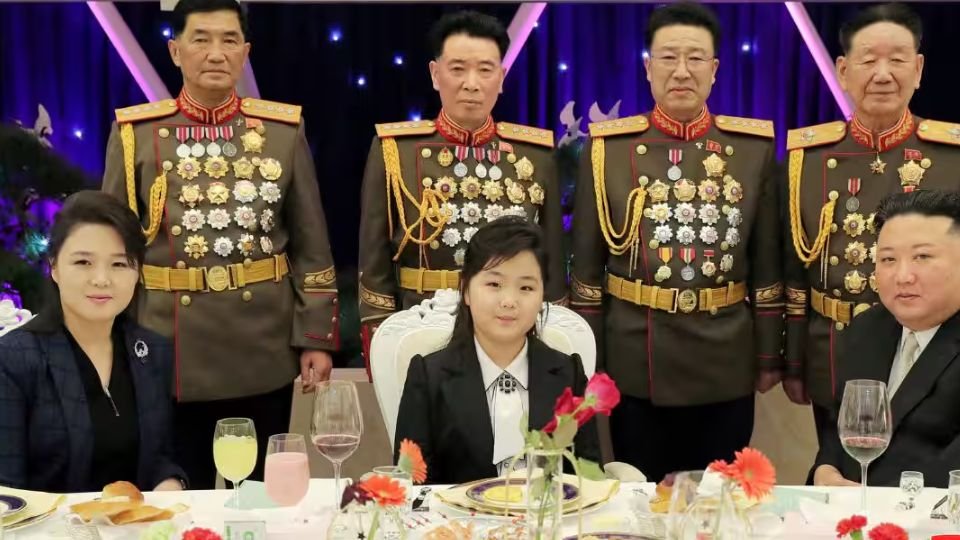
Kim Jong Un’s daughter, Kim Ju Ae, made her first public visit to the Kumsusan Palace of the Sun on Friday, appearing alongside her father at the mausoleum that houses former North Korean leaders Kim Il Sung and Kim Jong Il. Images released by the state-run Korean Central News Agency (KCNA) showed Ju Ae standing in a position traditionally reserved for the country’s supreme leader, intensifying speculation around a possible fourth-generation succession plan.
The visit comes amid North Korea’s long-established political structure, where the Kim family has retained centralised power for decades, supported by state ideology built around the so-called Paektu bloodline, referred to domestically as a source of national legitimacy. Kim Jong Un is currently the third ruler in the dynasty, having followed his father Kim Jong Il and grandfather Kim Il Sung, both posthumously promoted as “eternal leaders” in North Korean propaganda.
Ju Ae first appeared publicly in 2022 during a high-profile intercontinental ballistic missile (ICBM) test launch. Since then, North Korean state media has referred to her using honorific titles such as “the beloved child” and “a great person of guidance” (hyangdo/hyangdoja) — expressions historically used only for designated successors or senior leadership figures.
South Korea’s intelligence agencies previously indicated that Ju Ae was being positioned for a leading role after accompanying her father during a diplomatic engagement in Beijing last year, a development analysts interpreted as a deliberate signal of her growing prominence. Political analyst Cheong Seong-chang of Seoul’s Sejong Institute, who has authored a book on Kim family leadership, noted that Ju Ae’s placement at the centre of the front row inside the palace could be interpreted as a symbolic declaration to her ancestors that she is being prepared for national leadership responsibilities.
North Korea is often referred to externally as the world’s only communist hereditary monarchy, where political rank, military visibility, and ideological symbolism carry as much weight as institutional title. Some analysts have also suggested that Ju Ae could be elevated to the role of First Secretary of the Central Committee, the second most powerful position in the ruling Workers’ Party of Korea (WPK), during a major party congress expected to be held in the coming weeks.
Additional footage from Thursday showed Ju Ae attending New Year celebrations in Pyongyang, while First Lady Ri Sol Ju maintained a lower profile. The state broadcast also captured a rare moment of public familial affection, where Ju Ae touched Kim Jong Un’s face and kissed him on the cheek — imagery that received widespread attention in South Korea’s media.
Although North Korea has not officially confirmed a successor, Ju Ae’s increasing public appearances, military event attendance, diplomatic visibility, and ideological titles continue to build a strong case that she is being prepared for a future leadership role in the country’s political hierarchy.

