



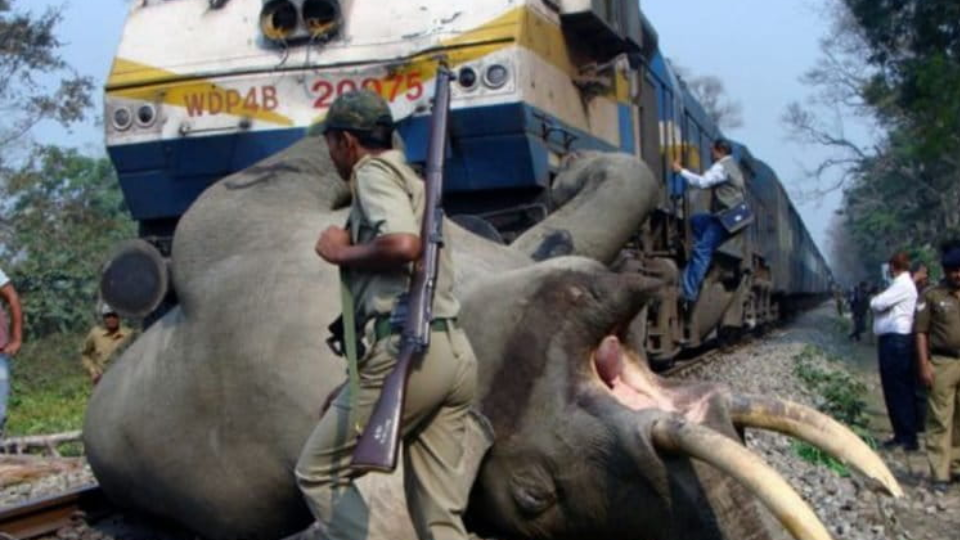
A tragic early-morning collision between a passenger train and a wild elephant herd in Assam led to the derailment of multiple coaches and the death of several animals, officials confirmed on Saturday.
The New Delhi-bound Sairang–New Delhi Rajdhani Express struck a group of elephants in Hojai district of Assam around 2.17 am, causing the locomotive and five coaches to derail. While no passengers were injured, forest authorities said eight elephants were killed and one calf was rescued with injuries after the incident.
What Happened on the Tracks
According to railway officials, the train driver applied emergency brakes after spotting the herd on the tracks. Despite the effort, the elephants reportedly ran into the moving train, triggering the collision and derailment. The site of the accident is not a notified elephant corridor, officials clarified.
The train connects Sairang near Aizawl in Mizoram to Anand Vihar Terminal in Delhi, serving as a key long-distance rail link to the Northeast. News agency PTI reported that accident relief teams and senior railway officers were rushed to the spot soon after the mishap.
Passenger Safety and Rail Disruptions
Passengers from the affected coaches were temporarily shifted to vacant berths in other compartments. Railway authorities said additional coaches would be attached once the train reaches Guwahati, after which it will continue its journey.
Rail movement toward Upper Assam and other parts of the Northeast was disrupted for several hours due to debris and elephant remains on the tracks. Helpline numbers were activated at Guwahati Railway Station to assist passengers.
A Recurring Wildlife Concern
The Assam incident comes amid growing concern over wildlife deaths on railway lines. Last month, a similar case was reported from Jalpaiguri district in West Bengal, where an adult elephant died and a calf was injured after being hit by a train.
Data shared in Parliament of India shows that 79 elephants have died in train-related accidents over the last five years. Minister of State for Environment Kirti Vardhan Singh informed lawmakers that the figures were compiled from state and Union Territory reports between 2020–21 and 2024–25.
Measures to Prevent Future Collisions
Authorities say several steps are being taken jointly by the Railways and the Environment Ministry to reduce such incidents. These include speed restrictions in forested stretches, use of seismic sensors to detect elephant movement near tracks, and the construction of underpasses, ramps, and fencing at vulnerable locations.
The Wildlife Institute of India has also issued detailed guidelines on eco-friendly infrastructure planning to reduce human–animal conflict. In addition, training workshops for railway staff were conducted in 2023 and 2024 to improve awareness about wildlife protection.
Officials said 77 high-risk railway stretches across 14 states have already been identified for targeted safety interventions, as India continues to grapple with balancing transport infrastructure and wildlife conservation.

